
How do I choose the right filling machine?
When choosing which filling machine is the right one for you, the best method is to focus on your requirements of the system and identify the ideal specifications. Some of the main things to consider are:
The viscosity. Does the liquid in question flow freely, or is it a higher viscosity? In general terms, the higher a liquid’s viscosity, the fewer filling options there are available.
Free-flowing, low viscosity liquids can often be filled by either a volumetric system which uses a pneumatically powered piston to displace a predetermined amount of liquid, or by a vacuum filling system which uses a special filling nozzle arrangement to draw liquid into the bottle by suction.
The container. The size, shape, and material a container is made from will influence the type of machine used to fill it. Most rigid plastic or glass bottle can be filled with thinner, free-flowing liquids via a vacuum-level filling machine, whilst jars, flexible bottles or pouches are likely to require a volumetric filling system. Large containers above 5-litres may require a volumetric system with a mobile ‘Wander Nozzle’ to allow the operator to fill the containers at ground level.
Fill accuracy. The level of accuracy required can also influence the choice of liquid filling system. In situations where the finished product is visible within the bottle and displayed in a retail environment, a vacuum level filling system may be appropriate because it will fill bottles to the same height, regardless of any differences from one container to another. This is particularly useful when filling glass bottles as the glass thickness can vary substantially.
Where a consistent, dependable fill volume is required and the aesthetics of several bottles displayed side-by-side on a shelf is not important, a volumetric filling system will provide a greater level of accuracy (commonly +/-0.5%). Volumetric filling systems work with a wider range of viscosities and container types.
Many of our volumetric filling machines have the added benefit of a variable, user specified ‘secondary fill volume’ which reduces the filling speed towards the end of each cycle, preventing liquid from splashing out of the top in the final stage of filling.
Production scale. The number of containers to be filled has a direct correlation with the level of automation the suitable filling system should have. Production scales of a between a few dozen and a few hundred can – in many cases – be achieved using either a manual or semi-automatic filling system, whereas regular production runs upwards of 1,000 are likely to require a greater level of automation through the filling process to achieve a high enough production rate. Semi-automatic and manual filling systems tend to be quicker to clean and changeover for a different filling application than fully automatic filling systems.
Production scales can be increased in several ways: conveyor systems to pass containers through the filling process automatically, multi-headed filling systems can fill up to 12 containers simultaneously, rotary infeed and outfeed tables can allow operators to place and remove numerous containers more rapidly. Additional systems can also be added such as capping and labelling to further increase production output.
Production environment. Manual filling machines such as our Handifill range can – for the most part – be used almost anywhere provided there is a firm surface to secure the machine to. Semi- automatic and fully automatic filling equipment will require either a supply of compressed air, electricity or both. Our liquid filling systems can be specified for use in ATEX environments.
Other considerations. Apart from the items listed above, there are a few other things to consider when choosing the right filling machine for your application. The type of liquid is a major factor. The contact parts within our filling machines are made from food- and pharmaceutical-grade 316 stainless steel.
Hoses, internal seals and valve assemblies are often specified to suit the type of liquid to be filled, whether it be Whisky or printer ink, paint or car wax; the materials used within the filling system need to be specified to suit to avoid contamination or premature seal degradation and failure. For example, piston seals which can withstand the rigours of dispensing acids may not be accredited for use within food or drinks production.
Another item influenced by the liquid type is the nozzles used. Nozzles are made to suit each application, container types and fill volume. Although often overlooked, the nozzle design can have a huge impact on the capability of a filling system to cleanly and efficiently fill containers time and again.
The characteristics of a liquid also play a part in the specification of a filling system and its nozzle design. Particularly ‘sticky’ liquids, such as syrup, may be similar viscosity to a hair gel, yet is likely to ‘cling’ to surfaces more readily than gel. Equally, printer ink can be the same viscosity as detergent but less likely to foam when dispensed. These characteristics will be addressed in the design of the nozzle in order to dispense cleanly and efficiently.
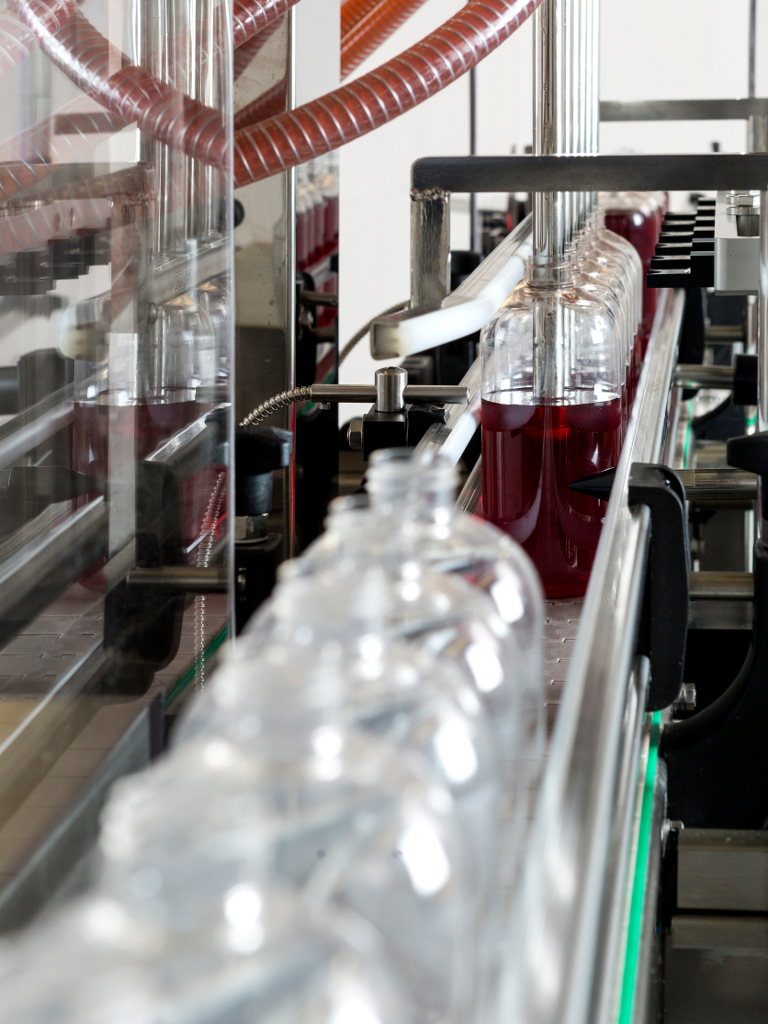

How do I choose the right filling machine?
When choosing which filling machine is the right one for you, the best method is to focus on your requirements of the system and identify the specification. Some of the main things to consider are:
The viscosity. Does the liquid in question flow freely, or is it a higher viscosity? In general terms, the higher a liquid’s viscosity, the fewer filling options there are available.
Free-flowing, low viscosity liquids can often be filled by either a volumetric system which uses a pneumatically powered piston to displace a predetermined amount of liquid, or by a vacuum filling system which uses a special filling nozzle arrangement to draw liquid into the bottle by suction.
The container. The size, shape, and material a container is made from will influence the type of machine used to fill it. Most rigid plastic or glass bottle can be filled with thinner, free-flowing liquids via a vacuum-level filling machine, whilst jars, flexible bottles or pouches are likely to require a volumetric filling system. Large containers above 5-litres may require a volumetric system with a mobile ‘Wander Nozzle’ to allow the operator to fill the containers at ground level.
Fill accuracy. The level of accuracy required can also influence the choice of liquid filling system. In situations where the finished product is visible within the bottle and displayed in a retail environment, a vacuum level filling system may be appropriate because it will fill bottles to the same height, regardless of any differences from one container to another. This is particularly useful when filling glass bottles as the glass thickness can vary substantially.
Where a consistent, dependable fill volume is required and the aesthetics of several bottles displayed side-by-side on a shelf is not important, a volumetric filling system will provide a greater level of accuracy (commonly +/-0.5%). Volumetric filling systems work with a wider range of viscosities and container types.
Many of our volumetric filling machines have the added benefit of a variable, user specified ‘secondary fill volume’ which reduces the filling speed towards the end of each cycle, preventing liquid from splashing out of the top in the final stage of filling.
Production scale. The number of containers to be filled has a direct correlation with the level of automation the suitable filling system should have. Production scales of a between a few dozen and a few hundred can – in many cases – be achieved using either a manual or semi-automatic filling system, whereas regular production runs upwards of 1,000 are likely to require a greater level of automation through the filling process to achieve a high enough production rate. Semi-automatic and manual filling systems tend to be quicker to clean and changeover for a different filling application than fully automatic filling systems.
Production scales can be increased in several ways: conveyor systems to pass containers through the filling process automatically, multi-headed filling systems can fill up to 12 containers simultaneously, rotary infeed and outfeed tables can allow operators to place and remove numerous containers more rapidly. Additional systems can also be added such as capping and labelling to further increase production output.
Production environment. Manual filling machines such as our Handifill range can – for the most part – be used almost anywhere provided there is a firm surface to secure the machine to. Semi- automatic and fully automatic filling equipment will require either a supply of compressed air, electricity or both. Our liquid filling systems can be specified for use in ATEX environments.
Other considerations. Apart from the items listed above, there are a few other things to consider when choosing the right filling machine for your application. The type of liquid is a major factor. The contact parts within our filling machines are made from food- and pharmaceutical-grade 316 stainless steel.
Hoses, internal seals and valve assemblies are often specified to suit the type of liquid to be filled, whether it be Whisky or printer ink, paint or car wax; the materials used within the filling system need to be specified to suit to avoid contamination or premature seal degradation and failure. For example, piston seals which can withstand the rigours of dispensing acids may not be accredited for use within food or drinks production.
Another item influenced by the liquid type is the nozzles used. Nozzles are made to suit each application, container types and fill volume. Although often overlooked, the nozzle design can have a huge impact on the capability of a filling system to cleanly and efficiently fill containers time and again.
The characteristics of a liquid also play a part in the specification of a filling system and its nozzle design. Particularly ‘sticky’ liquids, such as syrup, may be similar viscosity to a hair gel, yet is likely to ‘cling’ to surfaces more readily than gel. Equally, printer ink can be the same viscosity as detergent but less likely to foam when dispensed. These characteristics will be addressed in the design of the nozzle in order to dispense cleanly and efficiently.
How do I choose the right filling machine?
When choosing which filling machine is the right one for you, the best method is to focus on your requirements of the system and identify the idea specification. Some of the main things to consider are:
Selecting the right liquid filling machine for your product is one of the most important decisions when setting up or upgrading a production line. The correct bottle filling machine will improve accuracy, reduce product waste, increase production speed, and ensure consistent results across every batch.
Several factors influence which liquid filling equipment is most suitable for your application. Below are the key considerations to help you choose the right manual, semi-automatic, or automatic filling machine.
1. Liquid Viscosity
One of the first things to consider when choosing a liquid filling machine is the viscosity of the product being filled.
Does the liquid flow freely, like water or alcohol, or is it thicker and more viscous, such as sauces, oils, creams, or syrups?
In general terms, the higher the viscosity of the liquid, the fewer filling technologies are suitable.
Low-Viscosity Liquids
Free-flowing liquids such as:
-
water
-
spirits and alcoholic drinks
-
perfumes
-
solvents
-
detergents
can often be filled using either:
Volumetric Filling Machines
A volumetric liquid filling machine uses a pneumatically powered piston to dispense a precise, pre-determined volume of liquid into each container. This technology is widely used for accurate dosing across many industries.
Vacuum Level Filling Machines
A vacuum level filling machine uses a specialised filling nozzle to draw liquid into the bottle by suction. This method fills containers to a consistent visual level, making it ideal for clear bottles used in retail environments.
2. Container Type and Size
The container being filled is another critical factor when selecting the right bottle filling machine.
The size, shape, and material of the container will influence the type of filling technology required.
For example:
-
Glass bottles and rigid plastic bottles containing thin liquids are often well suited to vacuum level filling machines.
-
Jars, flexible plastic bottles, and pouches typically require a volumetric filling machine.
-
Large containers such as 5-litre, 10-litre, or 25-litre containers are usually filled using volumetric piston filling systems.
For large containers, many manufacturers use a Wander Nozzle, which allows operators to fill containers directly on the floor without lifting them onto the machine. This improves ergonomics and speeds up production.
3. Fill Accuracy
The level of fill accuracy required can also influence the type of liquid filling equipment used.
When Consistent Bottle Appearance Matters
If the finished product will be displayed on retail shelves, visual consistency is often important. Customers expect every bottle to appear equally full.
In these cases, a vacuum level filling machine can be ideal because it fills bottles to the same height rather than the same volume. This compensates for variations in bottle manufacturing.
For example, glass bottle thickness can vary, which means the internal volume of bottles may not be identical. Vacuum filling ensures the liquid level looks consistent across every bottle.
When Precise Volume Matters
Where exact fill volume is more important than visual appearance, a volumetric liquid filling machine is often the better option.
Volumetric systems can typically achieve fill accuracy of around ±0.5%, making them ideal for:
-
food production
-
cosmetics
-
chemicals
-
pharmaceuticals
-
high-value liquids
They are also capable of handling a much wider range of liquid viscosities and container types.
Many modern semi-automatic volumetric filling machines also include a secondary fill speed control. This slows the filling rate near the end of the cycle to prevent splashing, foaming, or product overflow.
4. Production Scale
Your production output requirements will determine whether you need a manual, semi-automatic, or fully automatic liquid filling machine.
Small-Scale Production
If you are filling:
-
a few dozen bottles per run
-
small batches for testing or startups
-
craft or specialist products
a manual filling machine or semi-automatic bottle filling machine is often the most practical solution.
These systems are typically:
-
more affordable
-
easier to clean
-
quicker to change between products
-
ideal for flexible production environments.
Medium to High Production
If you regularly fill hundreds or thousands of containers per day, a semi-automatic or automatic filling line will significantly improve efficiency.
Production capacity can be increased through:
-
multi-head filling machines that fill several bottles simultaneously
-
conveyor-fed filling systems that automate container movement
-
rotary infeed and outfeed tables for faster container handling
-
integrated capping and labelling machines.
Fully automatic liquid filling lines are typically designed for high-volume manufacturing environments.
5. Production Environment
The production environment can also influence the type of liquid filling equipment required.
Manual filling machines, such as simple hand-operated bottle fillers, can often be installed almost anywhere provided they are securely mounted to a stable surface.
However, semi-automatic and automatic filling machines generally require:
-
compressed air
-
electrical power
-
or both.
In some industries — particularly chemical, solvent, or pharmaceutical production — filling equipment may also need to be designed for ATEX environments, where explosive atmospheres are possible.
6. Liquid Compatibility and Materials
The type of liquid being filled plays a major role in the specification of a liquid filling machine.
High-quality filling machines are designed with food- and pharmaceutical-grade materials to ensure hygiene, durability, and compatibility with a wide range of liquids.
For example, many professional filling systems use 316 stainless steel contact parts, which provide excellent resistance to corrosion and chemical attack.
Other components — such as hoses, seals, and valve assemblies — are also selected to suit the product being filled.
A filling machine used for whisky, cosmetics, or beverages may require different materials than one used for solvents, acids, inks, or industrial chemicals.
Using the correct materials helps prevent:
-
contamination
-
premature seal wear
-
chemical degradation
-
equipment failure.
For example, piston seals suitable for dispensing acids may not be approved for food production, so the correct specification is essential.
7. Filling Nozzle Design
The filling nozzle is often overlooked, but it plays a major role in how efficiently and cleanly a liquid filling machine operates.
Nozzles are typically designed to suit:
-
the type of liquid
-
container shape and opening size
-
fill speed
-
viscosity and foaming characteristics.
Different liquids behave in different ways during filling.
For example:
-
Syrups and sugary liquids can be sticky and cling to surfaces.
-
Hair gels and thick cosmetics may flow slowly but cleanly.
-
Printer inks and detergents may have similar viscosity but very different foaming characteristics.
A properly designed filling nozzle ensures the liquid is dispensed cleanly, accurately, and consistently, reducing waste and keeping containers free from drips or splashes.
✅ Choosing the right liquid filling machine ultimately depends on several interconnected factors, including:
-
liquid viscosity
-
container type and size
-
required fill accuracy
-
production volume
-
working environment
-
material compatibility.
Working with an experienced filling machine manufacturer can help ensure the equipment is correctly specified for your product and production requirements.